
Feminist Theologies: An Excerpt

It is deeply gratifying to see my newest book, Feminist Theologies, co-written with Dr. Susan Shaw, released into the world.
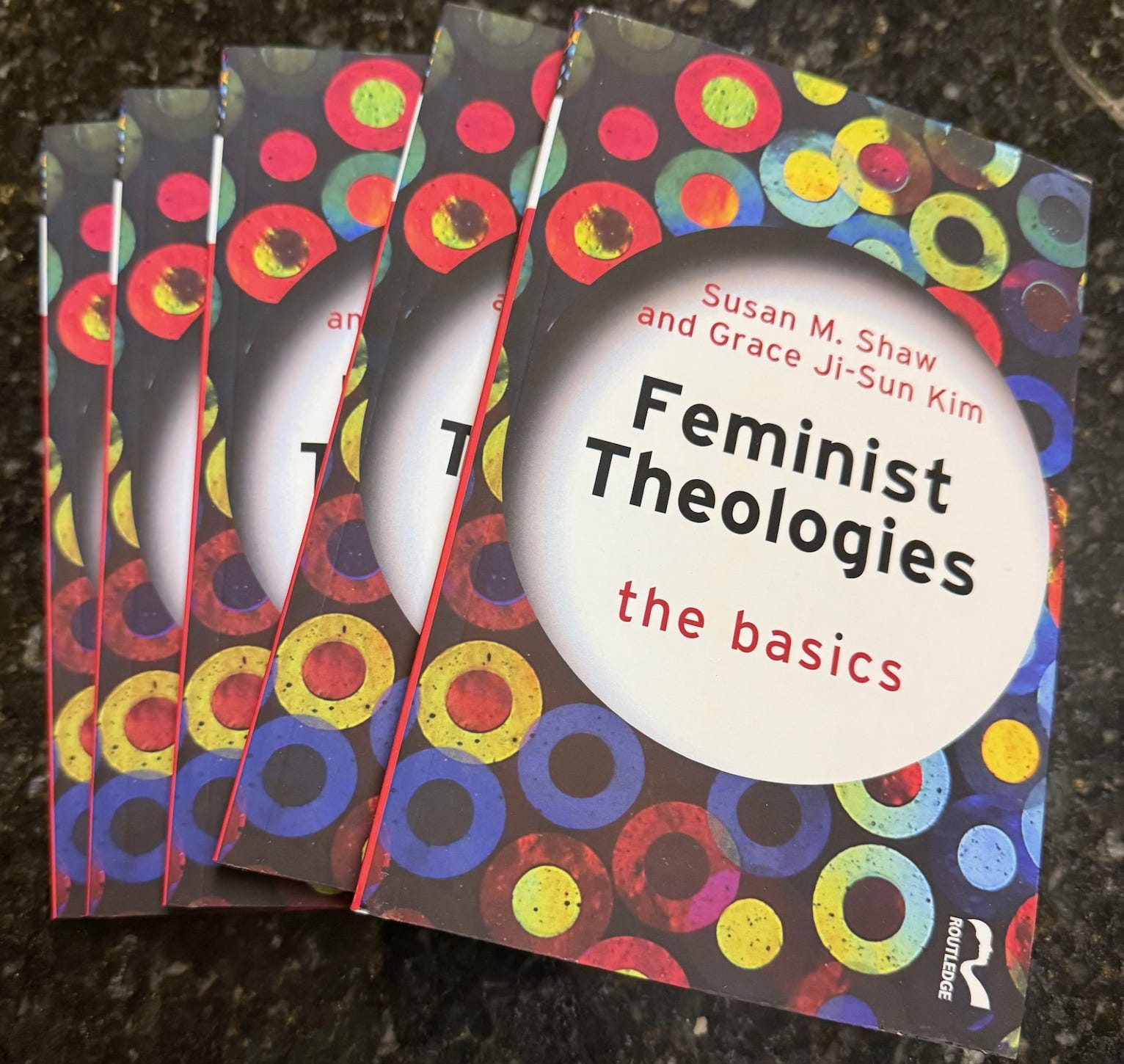
This is my 26th book and my third collaboration with Dr. Susan Shaw. Our first book together, Intersectional Theology, is widely used as a standard textbook in seminary theology courses. Surviving God is also being used in both academic settings and churches.
We hope that our third book together, Feminist Theologies, will be used widely in both the church and the classroom. Below is a short excerpt from the book’s Introduction.
Introduction to Feminist Theologies
Beginning with Jesus’ inner circle, women have always been an integral part of the development of Christian faith and practice. Though not named as such by the gospels but rather indicated by her behaviors and Jesus’ behavior toward her, Mary Magdalene was a disciple. Lydia hosted an early form of church in her home. Phoebe was a deacon. Some scholars theorize that a woman may have written the biblical book of Hebrews.
Women show up all over early Christian sources. In fact, women were the majority of Christians in the Roman Empire, and their predominance and active roles in the movement led to great derision by contemporary critics of Christianity. As the new religion institutionalized into the Church, however, women systematically lost power as it was consolidated in the hands of the men who led the Church.
As the Church developed in the first and early second centuries, Christian Apostolic Fathers and Apologists (defenders of the faith) began to articulate beliefs and practices into a coherent systematic theology. Theology is the study of God (and related concepts such as human nature, sin, and redemption). Only men were Apostolic Fathers, and, while women were apologists, their work was generally marginalized and ignored by men in power.
Despite their exclusion from the development of systematic theology, women participated actively in religious communities, wrote about their faith, and shaped Christian thinking across the centuries. Christian mystic women in the Middle Ages such as Hiledgard of Bingen, Julian of Norwich, Catherine of Siena, and Teresa of Avila wrote passionately about their personal, intimate encounters with the Divine. Devoted to lives of prayer, contemplation, and service, these women had a great infuence on their followers, women and men alike, including bishops and popes.
Still, men and their concerns were predominant in the Church and the development of its beliefs and practices. Individual women may have had influence now and again or served as leaders and members of religious communities for women, but, on the whole, the Church became a thoroughly patriarchal (male-dominated) institution through intentional decisions and actions.
Women’s writings were not valued as much as men’s, and often these writings were perceived by men in power as a threat to their power. Much of women’s writings were lost or purposefully suppressed. As academic texts became prioritized as standards for Christian belief and practice, women’s writings, which usually focused more on the everyday, the mundane, the emotional, and experiential, were marginalized.
These trends continued through the 16th and 17th centuries’ Protestant Reformation (a religious and political movement that splintered the Catholic Church and gave rise to a number of Protestant denominations like the Lutherans and Presbyterians). While a few offshoots of Protestantism, such as Quakers and some Baptists, supported women’s active engagement, on the whole, Protestant beliefs and practices continued the ongoing suppression of women’s involvement in the shaping of systematic theology.
The development of theology was also deeply affected by the modern era, which began with the Renaissance and included the Reformation and Enlightenment, and continues into the present. Modernism centers on individualism, rationalism, scientific method, and the modern nation-state. The idea of the nation-state emphasizes national identity and sovereignty. This emphasis encouraged European nations to expand their territories by colonizing other lands, subjugating their people, and taking their resources.
In concert with the political movement to colonize, many European theologians created justifications for colonial expansion by appealing to Divine will and Manifest Destiny. European missionaries aided in the conquest by taking a form of Christianity to other parts of the world that taught the subordination of Indigenous people as a facet of the Christian faith. Alongside this, missionaries also carried patriarchal notions of gender to other places in the world. (Feminist Theologies, p.1-3)
**Shaw has been on Madang Podcast hosted by Faith and Reason twice. Listen to this episode as she discusses our book, Surviving God.
Special Events:
Order When Did We See You? A Lenten Exploration of Poverty and Wealth from The Upper Room. Use discount code MADANG at checkout for 20% off.

I will be preaching at Fairview Presbyterian Church, Indianapolis, on January 18th and will lead the Adult Forum on Earthbound. Please join me.

Come to Westwood United Methodist Church on Jan 23rd-24th for a “Sacred Summit.” All registered will receive a free copy of When God Became White, and lunch is included. Register here.
Join me for A Writing Retreat to Stir the Soul, Feb 20-22nd. All writers at any level are welcome and scholarships are available.


Just added your new book to my shopping cart!! THANK YOU!!